Customers
How utilities and grid operators use Singularity in production.
Production deployments at Southern Company, MISO, and SPP. What each program required and how it runs.
Georgia Power’s renewable customers, by source and by hour.
Large C&I customers were pushing for more: transparent data on their energy supply, their hourly carbon footprint, and how their renewable subscriptions were performing. Southern Company evaluated existing internal systems and marketplace alternatives, looking specifically for data quality, flexibility to meet future needs, and the ability to incorporate customer feedback — then partnered with Singularity. The underlying generation, metering, and program data existed. The allocation engine, certificate tracking, and methodology to turn that data into auditable hourly reports didn't. Singularity built all of it — and automated the internal program management that makes it sustainable to run.
In 2024, Georgia Power ran a 6-month pilot with 10 C&I customers. The results validated the approach and led to scaled deployment across Georgia Power's renewable program customers.
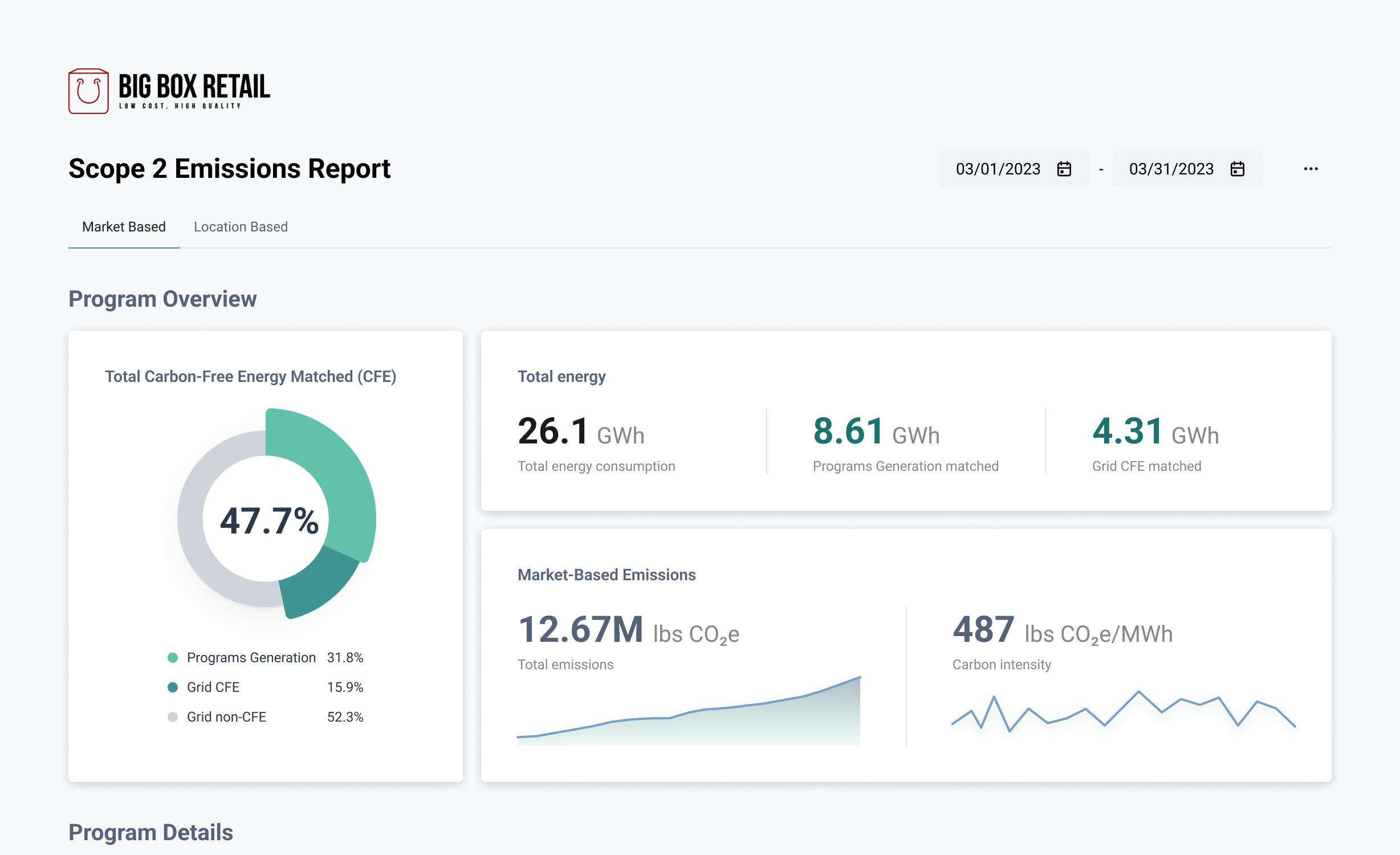
For Georgia Power’s customer solutions team, that meant having answers when large C&I customers asked about their supply mix, emissions, and program impact, without manually pulling data from multiple systems. In a July 2026 announcement, Georgia Power and Google described what the platform makes possible:
"The platform that Singularity helped develop provides customers with hourly energy and emissions data, as well as an overall picture of their sustainability metrics not previously possible."Cam Hardin, Director of Customer Solutions, Georgia Power
"Google’s goal is to match the entirety of our hourly electricity consumption with carbon-free energy by 2030. This goes far beyond traditional sustainability goals, requiring detailed electricity and carbon data to measure progress and inform action. The high-quality data we received during our pilot with Georgia Power has enabled us to transition from a carbon-accounting mindset to carbon action."Soazig Kaam, Technical Program Manager, Google Energy Products
Carbon intensity at the county level, every hour, across 15 states.
MISO is one of the largest grid operators in the country — 15 states from Louisiana to North Dakota. Its member utilities and states were pursuing emissions goals but couldn't get specific enough to act: which hours were cleanest, which counties had the most exposure, how much clean energy from a given source was actually reaching a given load.
Singularity built the infrastructure. CarbonFlow traces power flows from generators across MISO's transmission network to the substations where loads are served, calculating per-generator emissions rates in real time — because every generator's heat rate shifts hour to hour. The underlying work is the same Singularity does inside utilities: integrating operational data from systems that weren't designed for it, and producing outputs precise enough to hold up under scrutiny.
The result is a publicly accessible consumed emissions dashboard — near-real-time at the regional and state level, hourly county-level data available quarterly. The logic behind it, as Singularity's head of research and policy Greg Miller puts it:
"We can't trace individual electrons, just like we don't trace water molecules in a river. But we can trace larger power flows from generators to the loads where these flows are going."Greg Miller, Head of Research and Policy, Singularity Energy
Once the attribution is clear, each kilowatt-hour has one owner. Double-counting becomes traceable. Utilities managing green tariff programs, states tracking renewable targets, and large corporate CFE buyers all draw on it.
That foundation now supports a second service. In July 2026, MISO introduced Locational Marginal Emissions (LME) — adding a complementary layer to what members can access. Where the consumed emissions dashboard shows what's in the electricity supply mix each hour, LME shows the emissions impact of each additional unit of load: which generator is on the margin, and what it costs the grid in carbon to serve the next megawatt-hour. Both services are publicly accessible, built on the same underlying data infrastructure Singularity maintains for MISO.
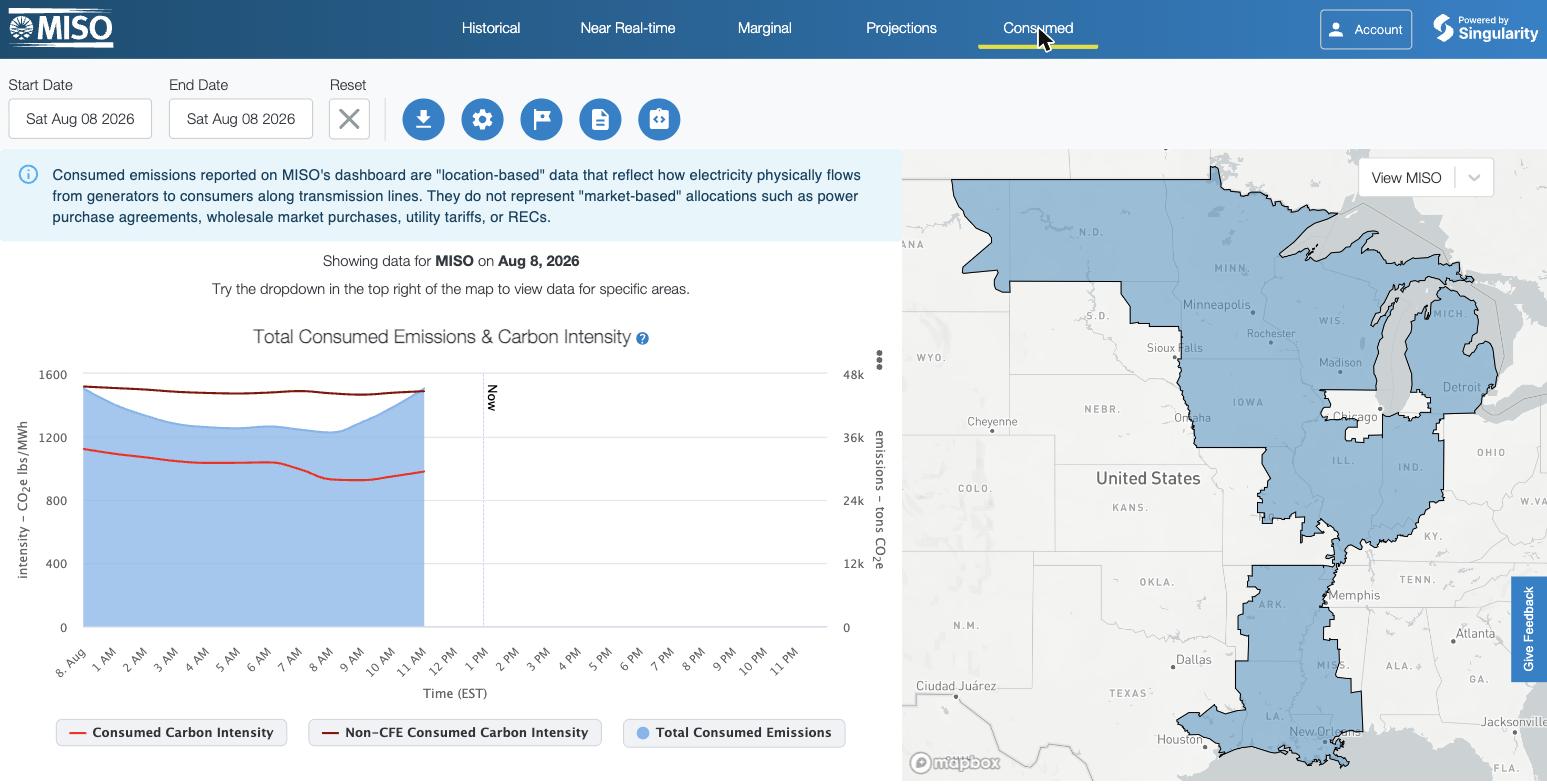
When the consumed emissions dashboard launched, an independent analyst described the significance for MISO's members:
"We're not talking minor academic interest here — we're talking real money. What fraction of the enormous amount of capital going into our sector can ignore carbon implications? It has to be validated."Kathleen Spees, Principal, The Brattle Group
Canary Media, May 2025
Source-by-source emissions accounting for SPP's member utilities, every hour.
SPP's member utilities operate across the central U.S. As state and federal emissions disclosure requirements got more specific, utilities needed to show regulators and public utility commissions exactly what was in their electricity supply, by source and by hour. SPP had the data: generation records, metering data, market transaction records. It had no infrastructure to turn that data into auditable reports each member could actually file.
Singularity built that infrastructure on SPP's own operational records. Generation is traced by source across SPP's entire footprint each hour, allocated to member utilities based on actual load, and documented at each step. Member utilities access their specific GHG data through the platform. The public residual mix report has been available at SPP's portal since May 2026.
"This service helps our members track emissions, assisting them in adhering to regulations established by public utilities commissions and other state or federal regulatory bodies. Some of these entities have state-enforced goals, and this initiative helps them meet those requirements."Wendy Weaver, Senior Manager, Market Support and Analysis, SPP
Ready to see it on a real program?
We'll walk through how Singularity applies to your program structure. 30 minutes, no sales deck.
Get a demo →Large C&I buyer? If your utility runs a green tariff or clean energy program, ask them about the platform. The Georgia Power deployment with Google is an example of what that looks like.